Real Estate Proposal Examples: What Winning Proposals Look Like
Real examples of listing proposals from Australian agents — what a winning proposal looks like section by section, and what separates strong from weak.

A strong real estate proposal example opens with a personalised property summary – the vendor's name, the address, and a specific reference to their situation or timeline. It then moves to a CMA with three to five comparable sales and a clear price range, a marketing plan with specific portal and photography recommendations, a fee structure with itemised inclusions, and a track record section with recent results and two to three vendor testimonials. The weakest proposals skip the CMA entirely, use generic marketing copy that applies to any property, or read as a brochure about the agent rather than a plan built around the vendor's specific property and goals.
Reading about what a real estate proposal should contain is useful. Seeing what strong and weak versions of each section actually look like is more useful. Principles tell you what to aim for; examples show you whether you're hitting it.
This guide works through each core section of a listing proposal with concrete examples – the specific language, structure and level of detail that separates proposals that win listings from those that don't. It also covers the patterns that make weak proposals easy to identify, so agents can audit their own documents before they reach a vendor.
What does a real estate proposal example show?
A real estate proposal example shows the specific language, structure and level of detail that distinguishes a well-prepared, tailored proposal from a generic one – illustrating what each section should communicate and how to write it in a way that builds vendor confidence.
Examples are more instructive than templates because they show the thinking behind the structure. It's one thing to know that the pricing section should include comparable sales. It's another to see how an effective agent frames those comparables in writing.
Why examples matter more than principles
Most agents who produce weak proposals don't know they're weak. The sections are all present. The document looks complete. The problem is in the quality of the content – the pricing section is vague, the marketing plan is generic, the communication commitment is aspirational rather than specific.
Reading examples of strong proposals alongside weak ones makes the gap visible. It also makes it fixable – because the difference between a good proposal and a poor one is almost always a question of specificity, not structure.
The NAR Profile of Home Buyers and Sellers consistently finds that vendors rate agent preparation and communication quality as more important than commission when selecting who to list with. A strong proposal is the most direct demonstration of both. What follows shows what "strong" actually looks like in each section – with concrete listing proposal examples you can apply directly.
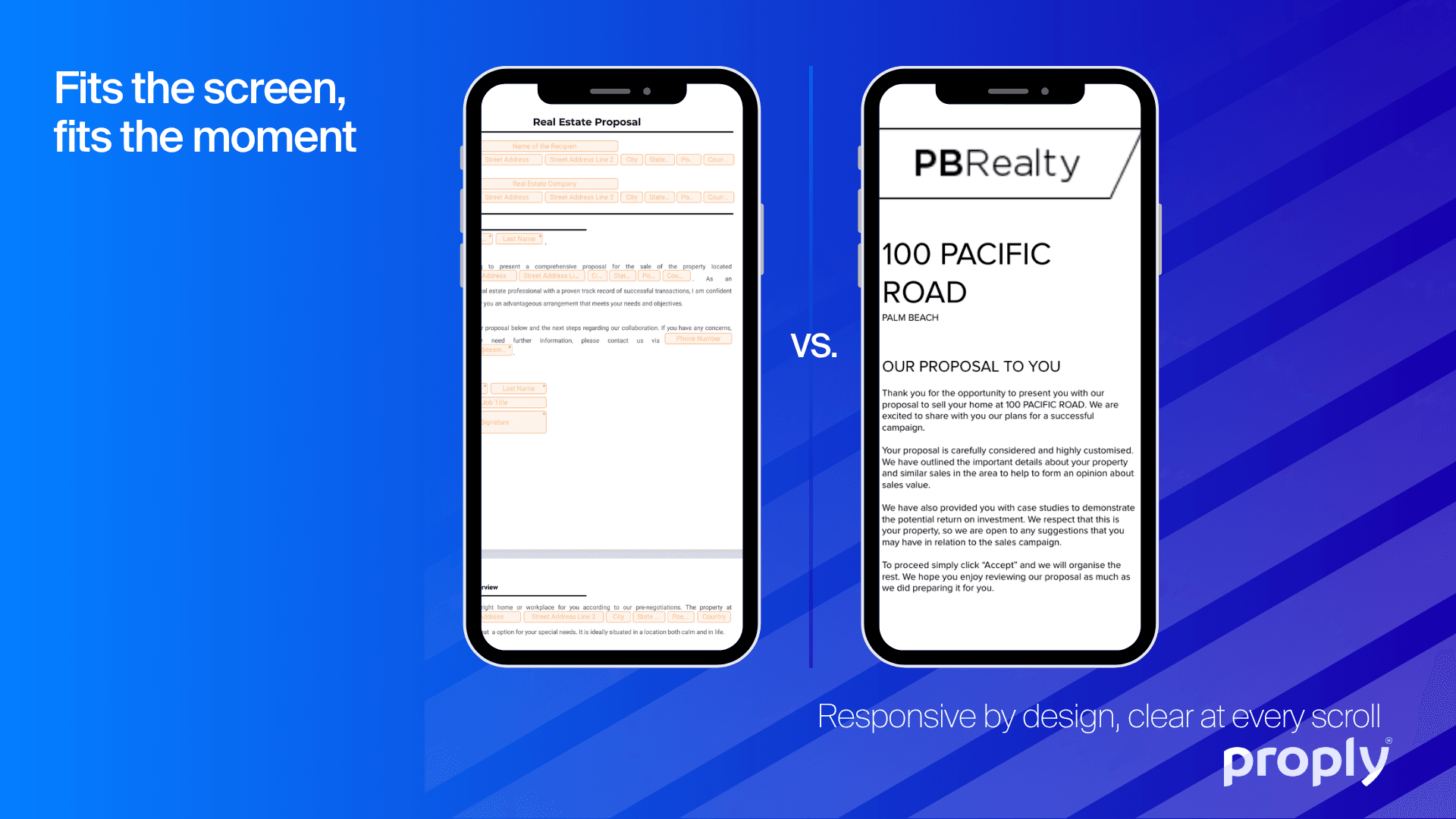
Example: a strong property overview
Weak version: "4 Elmwood Close is a well-presented four-bedroom family home in a sought-after location, offering comfortable living across two levels."
Strong version: "4 Elmwood Close is a four-bedroom, two-bathroom family home on 612sqm in the heart of the Willowdale school catchment. The property last sold in 2017 at $820,000 and has been significantly improved since – the kitchen and main bathroom were both renovated in 2021. Our campaign objective is to achieve a result above $1.15M within a 30-day listing window, targeting family upgraders currently active in the suburb."
The strong version does three things the weak one doesn't: it establishes the vendor's position clearly, it sets a specific campaign objective, and it identifies the buyer. The vendor reading the strong version knows the agent has done the work. The vendor reading the weak version knows they've read a sentence that could describe any property in any suburb.
Example: a credible pricing strategy section
Weak version: "Based on current market conditions and comparable sales in the area, we believe the property is likely to achieve in the range of $1.1M–$1.3M. We recommend taking the property to market via private treaty with a price guide consistent with this range."
Strong version: "Three comparable sales are directly relevant to your property's position in the current market:
– 12 Birchwood Avenue (sold March, $1.19M): 4 bed/2 bath on 580sqm, similar renovation standard. Sold in 11 days, two offers received. The smaller land component supports the upper end of our range for Elmwood.
– 8 Ridgemont Place (sold February, $1.08M): 4 bed/1 bath on 640sqm, original kitchen and bathrooms. This result establishes the floor for a property at your improvement level.
– 22 Thornton Street (sold April, $1.22M): 4 bed/2 bath on 595sqm, school-catchment premium evident in the result. Sold in 8 days, unconditional.
Our recommended range is $1.15M–$1.22M. We recommend private treaty with a price guide of $1.15M+ to attract the family upgrader buyer pool without capping expectations. Auction is an option if the vendor prefers a defined campaign timeline."
The strong version gives the vendor something to engage with – specific results, clear reasoning, and a recommendation with a rationale behind it. The REA Group Property Seeker Survey consistently shows that transparency around pricing methodology is one of the leading factors in building agent trust. The strong version delivers that; the weak version avoids it.
Example: Strong listing proposal structure
A strong listing proposal example follows this sequence:
- Property overview – specific to this property, with a clear campaign objective
- Pricing strategy – comparable sales with commentary, clear price range and method rationale
- Marketing plan – built around the buyer profile, every decision justified
- Communication plan – specific commitments, not aspirations
- Credentials – recent local results, not biography
- Fees and next steps – stated clearly, with a call to action

Example: a specific vs generic marketing plan
Weak version: "Our comprehensive marketing strategy includes premium portal advertising on realestate.com.au and domain.com.au, professional photography and copywriting, social media promotion, and regular open homes. We will maintain consistent communication with you throughout the campaign."
Strong version: "Our buyer for 4 Elmwood Close is a family upgrader with a budget of $1.1–1.25M, currently searching within a 5km radius of their existing home. Based on this profile, our strategy is:
Portal advertising: Premiere listing on realestate.com.au for the first four weeks (the window when search activity is highest for this buyer profile), supported by a Feature listing on Domain.
Photography: Full professional shoot with twilight exterior – Elmwood's north-facing rear aspect and outdoor entertaining area are the key buyer triggers for this price bracket.
Social advertising: Targeted Facebook and Instagram campaign to homeowners aged 35–50 within a 7km radius, running from listing day.
Database: Direct outreach to 48 registered buyers currently active in our system with matching criteria.
Open homes: Saturdays 11–11:45am for the first three weeks, with private inspections available by appointment for pre-qualified buyers.
Week 1 results meeting: In-person or video meeting on the Tuesday of the first open home week to review buyer feedback and adjust strategy if needed."
The difference is not volume – it's that every decision in the strong version is explained in terms of the buyer. Vendors who see this level of specificity understand that the agent has actually thought about their property.
Example: a communication plan vendors trust
Weak version: "We pride ourselves on keeping vendors fully informed throughout the campaign and will provide regular updates on enquiry, inspections and buyer feedback."
Strong version: "You'll receive a written campaign summary by 5pm every Tuesday, covering: number of portal enquiries and views, inspection attendances, buyer feedback (including specific objections or concerns raised), and any changes to strategy we're recommending.
After every open home, we'll call you within 90 minutes with a verbal summary of what we observed and heard from buyers.
If an offer is submitted, we will call you immediately, regardless of the day or time. We will not communicate an offer by email or text without first speaking to you by phone.
If the campaign reaches week three without strong buyer interest, we'll schedule a specific meeting to review pricing, marketing reach and any adjustments needed before week four."
The second version is a commitment, not an intention. Vendors who read it know exactly what they're going to receive. That certainty is what builds confidence in the agent before the campaign has started.

What weak proposals have in common
After reviewing the examples above, the pattern in weak proposals becomes clear:
They describe rather than commit. Weak proposals describe what the agent typically does. Strong proposals commit to what they will do for this property. The language shift from "we provide" to "you will receive" changes the entire register of the document.
They omit the buyer. The most consistent weakness in marketing sections is the absence of a clearly identified buyer profile. If the marketing plan doesn't start with who the buyer is, it's describing activity rather than strategy.
They hedge on pricing. A wide price range with no rationale is not a pricing strategy – it's a range the vendor could have generated themselves from an online estimate. Pricing sections that don't commit to a view undermine the agent's credibility in the section vendors scrutinise most.
They use agency language. Phrases like "multi-channel digital strategy", "premium brand exposure" and "extensive buyer database" sound professional to agents and mean nothing to vendors. The best proposals are written in plain language a vendor can evaluate without industry knowledge.
In a proposal-first selling approach, the proposal is what vendors compare when they're deciding between agents. Strong proposals make that comparison easy – and make the outcome clear.
proply gives agents a structured framework for building proposals that are consistent in quality across every appointment – so the standard of the document reflects the standard of the agent, not the amount of time available that week. For the full writing process behind strong proposals, see the guide to how to write a real estate proposal.
Download free – 64 pages on writing, structuring and delivering pre-listing proposals that win authority.
Ready to see proply in action? Book a proply demo · Start your free trial
This article is part of the proply blog – practical guides for Australian agents on proposals, listing presentations and winning more listings. Explore the full series at proplyapp.com.au/blog.