How to Write a Real Estate Proposal That Wins Listings
Step-by-step guide to writing a real estate proposal — structure, pricing strategy, marketing plan and vendor expectations. For Australian agents.

A real estate proposal for Australian agents should be structured in this order: a personalised opening that references the vendor's property and situation specifically, a CMA with a clear price range and recent comparable sales, a written marketing plan covering portal strategy, photography and budget, the proposed commission structure and what it covers, your relevant sales results and vendor testimonials, and a clear next steps section. The goal is a document specific enough to feel tailored and clear enough to survive a second read – by the vendor's partner, their adult children, or anyone else at the kitchen table when they're making the decision.
Most agents understand what a real estate proposal should contain. Fewer know how to write one that actually works – a document that's specific enough to feel tailored, clear enough to survive the kitchen-table conversation after the meeting, and persuasive enough to move a vendor from undecided to ready to sign.
The gap between knowing the sections and writing them well is a process problem. Agents who produce strong proposals consistently aren't necessarily better writers – they have a better method. They start in the right place, build the sections in the right order, and edit for clarity rather than completeness. This guide walks through that process.
How do agents write a real estate proposal?
Agents write a real estate listing proposal by starting with the vendor's specific situation and goals, then building each section – pricing strategy, marketing plan, communication approach and fees – around what that particular vendor needs to understand to make a confident decision. Strong proposals are tailored documents, not completed templates.
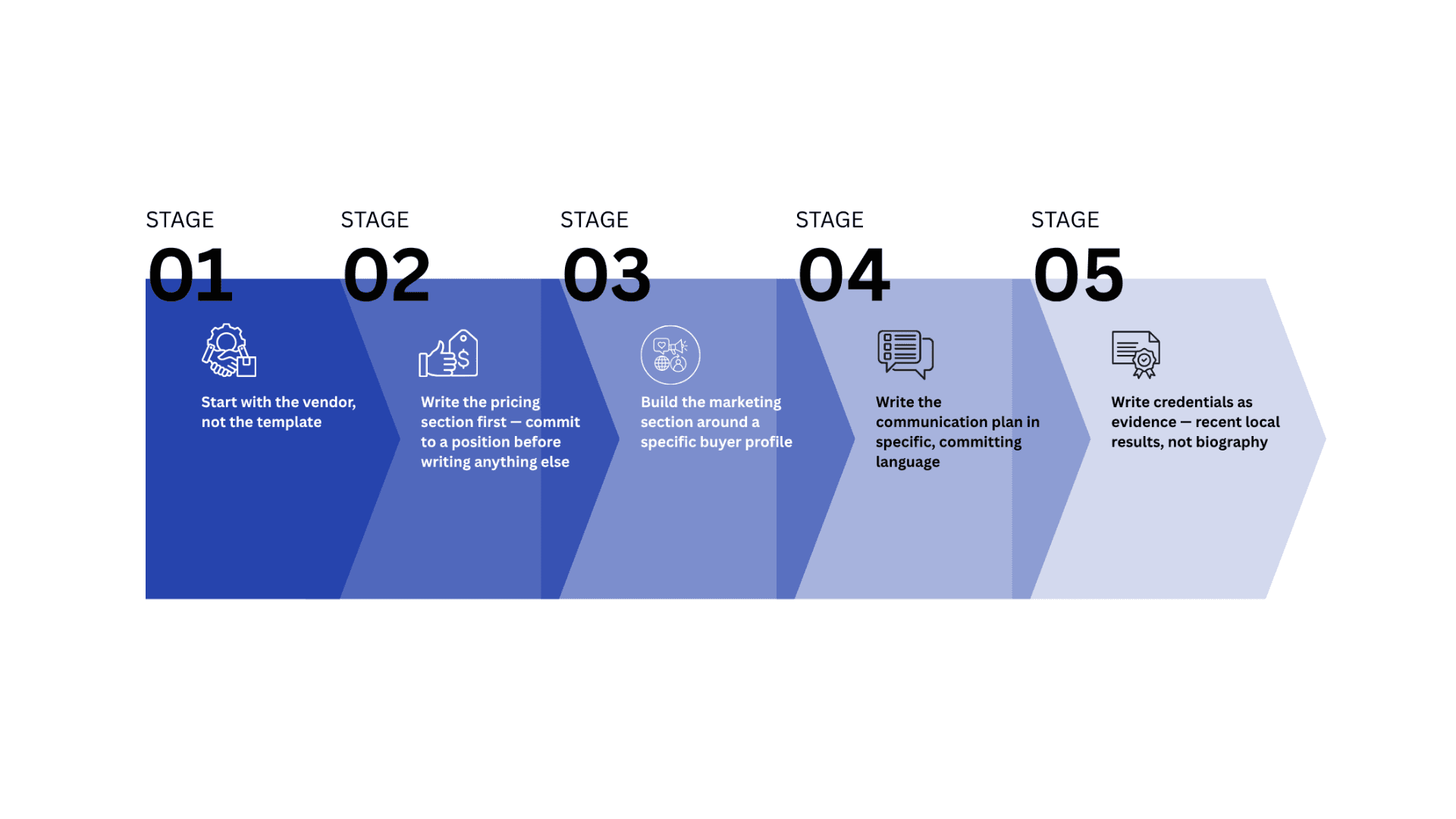
The process for writing a real estate proposal is:
- Start with the vendor's goals and situation
- Write the pricing section first – commit to a position before writing anything else
- Build the marketing section around a specific buyer profile
- Write the communication plan in specific, committing language
- Write credentials as evidence – recent local results, not biography
The distinction matters. A template gives you structure. The writing process gives the template meaning. An agent who fills in a template without adapting the substance produces a proposal that reads exactly like what it is: a template with the address changed.
Why most proposals read as generic
Generic proposals have a recognisable feel. They describe the marketing strategy in broad terms ("multi-channel digital campaign, premium portal listing, social media exposure") without explaining why those choices make sense for this property. They present comparable sales without interpreting them. They describe the communication process without committing to specifics.
The underlying problem is that many agents write proposals starting from the document rather than from the vendor. They open a template, fill in the fields, and consider the proposal complete. The result is a document that describes what the agent usually does rather than what they've decided to do for this property.
In a proposal-first selling workflow, the proposal is the centrepiece of the listing appointment – not a document completed after the fact. Writing it well requires thinking through the specific strategy before writing a single word.
Step 1: Start with the vendor, not the template
Before opening a document, work through the following questions for this specific property and vendor:
- What are the vendor's primary goals – maximum price, speed of sale, campaign simplicity, or something else?
- What is their timeline and how flexible is it?
- What do they already believe about the property's value, and where did that belief come from?
- Who is the most likely buyer for this property, and what does reaching them require?
- What objections will this vendor have – to pricing, to marketing budget, to the recommended method of sale?
The answers to these questions should shape every section that follows. A vendor under financial pressure and a downsizer with twelve months of flexibility need different proposals – not structurally different, but substantially different in emphasis and tone.
If you didn't get clear answers to these questions in the appraisal, the proposal will reflect that gap. The preparation drives the writing.
Step 2: Write the pricing section first
Most agents write the property overview first because it feels like the natural starting point. Start with pricing instead.
The pricing section is the section vendors scrutinise most carefully, and it's the one that most clearly reflects whether the agent has done the work. Writing it first forces you to commit to a position – a specific price range, a recommended method of sale, a rationale – before the rest of the document is shaped around it.
How to write it:
Open the section with a brief description of current market conditions in the suburb – not a paragraph of generic market commentary, but a specific statement about what's happening with buyer demand, active supply and recent sale results right now. One or two sentences.
Then walk through the comparable sales. Don't list them – explain them. For each comparable, note what it tells you about this property's likely position: "24 Elmwood, which sold in six days at $1.18M, had a similar land component but a significantly older improvement – which supports the upper end of our range for your property."
Close with a clear recommendation: price range, method of sale, and the specific reason this method suits this property and this vendor's timeline. Be direct. Vendors who receive a proposal with a clear pricing recommendation and the reasoning behind it are far more confident than those who receive a range with no rationale.
Step 3: Write the marketing section around the buyer profile
Marketing sections fail when they describe what the agent will do without explaining why. Start the section by identifying the buyer – specifically.
"The most likely buyer for this property is a family upgrader purchasing from within a 5km radius, with a budget of $1.1–1.3M and an active search window of the next 60 days. Our strategy is built around reaching that buyer where they're actively looking and creating urgency before competing listings enter the market."
Every marketing decision that follows should connect back to that buyer profile. Why this portal tier? Because that's where buyers in that price bracket are searching. Why this photography approach? Because the features most likely to attract that buyer – indoor/outdoor flow, kitchen, light – need to be the first thing they see.
Specificity turns a standard marketing section into a compelling one. The REA Group Property Seeker Survey shows vendors respond strongly to agents who demonstrate they understand who the buyer is and how to reach them. The marketing section of a real estate listing proposal is where that understanding is either shown or absent.
Step 4: Write the communication plan in specifics
Most communication plans read as aspirations rather than commitments. "We'll keep you regularly informed throughout the campaign" is not a communication plan – it's a reassurance that communicates nothing.
Write this section in specific, committing language:
"You'll receive a written campaign update by 5pm every Tuesday throughout the listing period, covering inspection numbers, buyer feedback, and any shifts in market conditions that affect our strategy. We'll also call you within two hours of every open home with a verbal summary of buyer feedback."
The specificity serves two purposes. For the vendor, it creates genuine confidence that they'll be kept informed. For the agent, it creates a framework they're now accountable to – which is exactly the kind of structure that separates well-managed campaigns from poorly managed ones.
McKinsey's research on AI and workflow in real estate consistently finds that explicit process commitments – stating what will happen, when and how – reduce client anxiety and improve outcomes. In real estate, the communication plan is that commitment in writing.
Step 5: Write credentials as evidence, not biography
The credentials section should answer one question: why should this vendor trust that you'll deliver what the rest of the proposal promises?
Biography doesn't answer that question. Results do. Write the credentials section around recent, relevant outcomes – comparable properties in the same suburb or price range, with results that speak directly to what this vendor wants.
"In the last twelve months, I've sold four properties within 500 metres of yours. The median days on market across those campaigns was 14, with an average sale price 2.8% above the initial listing price."
Two or three results like this, supported by a vendor testimonial where available, are more persuasive than a paragraph describing years of experience and agency affiliations.
Common proposal writing mistakes

Writing for completeness rather than clarity. A longer proposal is not a better one. Every sentence should earn its place. If a section can be cut without losing anything the vendor needs to know, cut it.
Using agency language instead of vendor language. Phrases like "multi-channel digital strategy" and "premium portal exposure" are familiar to agents and meaningless to most vendors. Write in the language your vendor uses.
Hedging on pricing. A proposal that offers a broad price range without clear reasoning – or that defers the pricing discussion entirely to "further discussion" – signals to vendors that the agent hasn't committed to a position. Vendors want an agent with a view, not one avoiding the conversation.
Copying sections across proposals. The marketing strategy section from last week's proposal in the same suburb might look very similar to this one – but if the vendor reads it and anything feels recycled, the damage is significant. Adapt every section, even if the substance is similar.
Sending without reviewing. A proposal with a factual error, a wrong address, or the wrong vendor's name is worse than no proposal at all. Review it, then have someone else check it before it leaves your hands.
Download free – 64 pages on writing, structuring and delivering pre-listing proposals that win authority.
Ready to see proply in action? Book a proply demo · Start your free trial
This article is part of the proply blog – practical guides for Australian agents on proposals, listing presentations and winning more listings. Explore the full series at proplyapp.com.au/blog.