Modern Real Estate Agent Workflow: From Appraisal to Won Listing
How top Australian agents structure their workflow in 2026 — from prospecting and appraisals through to proposals, follow-up and won listings.

A modern real estate agent workflow runs across five stages: prospecting and nurture, the appraisal, the pre-listing proposal, the listing presentation, and follow-up through to a signed agreement. Each stage has a job, an owner and a tool. The CRM manages the pipeline that produces appraisals; the appraisal sets the pricing conversation; the pre-listing proposal makes the case in writing; the listing presentation delivers it in person; and disciplined follow-up converts a strong meeting into a signature. High-performing agents in 2026 treat these as one connected sequence rather than five disconnected tasks – and they use a specific tool at each stage instead of forcing one platform to do everything.
This guide walks through each stage, what good looks like, and the tools that support it – so you can find the weak link in your own process and fix it.
What is a modern real estate agent workflow?
A modern real estate agent workflow is the end-to-end sequence an agent follows to convert a prospect into a won listing – from database prospecting and nurture, through the appraisal, pre-listing proposal and listing presentation, to follow-up and the signed agency agreement. Each stage uses a purpose-built tool: a CRM for the pipeline, property data platforms for pricing, and proposal software for the vendor-facing pitch.
The defining feature of the modern version is structure. Where agents once relied on a strong personality and a printed brochure, the agents winning listings today run a repeatable process where the vendor always knows what's coming next, and nothing falls through the gap between a promising appraisal and a signed listing.
Stage 1: Prospecting and nurture
The workflow starts long before the appraisal. Prospecting and nurture is the ongoing work of building and maintaining a database – past clients, current owners, buyer enquiries and referral sources – and staying in consistent contact until someone is ready to sell.
This is CRM territory. The CRM stores every contact and interaction, automates follow-up sequences so cold leads stay warm, and gives the agent a pipeline view of who's close to a listing decision. The agents who win the most appraisals aren't necessarily the best talkers; they're the most systematic about follow-up over months and years.
Choosing the right CRM for your agency matters here – the options, and how they differ, are covered in our guide to the best real estate CRM in Australia. The goal of this stage is simple: a steady, predictable flow of appraisal opportunities rather than a feast-or-famine pipeline.
Stage 2: The appraisal
The appraisal is where a prospect becomes a live listing opportunity. The agent visits the property, assesses it against the market, and begins the pricing conversation with the owner.
The critical input at this stage is data. Comparable sales evidence from platforms like Pricefinder, CoreLogic and PropTrack underpins a credible price estimate and protects the agent from over-promising to win the listing – a tactic that backfires later in the campaign. A strong appraisal balances an evidence-based price with a clear sense of the vendor's motivation and timeline.
The appraisal is also where the next stage is set up. The best agents don't leave the meeting with a verbal "I'll think about it." They leave having told the vendor exactly what they'll receive next: a tailored written proposal. That single commitment is what separates a structured workflow from a hopeful one.
Stage 3: The pre-listing proposal
This is the stage most agents under-invest in, and it's where listings are most often won or lost.
A pre-listing proposal is the tailored, vendor-facing document that sets out the agent's full case: comparable sales and pricing strategy, the marketing plan, fee structure, communication commitments and track record – sent to the vendor ahead of (or alongside) the listing presentation. It gives the vendor something concrete to review on their own time, share with their partner, and compare against other agents.
This is the heart of proposal-first selling – structuring the listing process around a clear, tailored proposal rather than relying on a slide deck delivered on the day. It works because it respects how vendors actually decide: research from the REA Group Property Seeker Survey consistently shows Australian sellers prioritise transparency, clarity of strategy and clear communication when choosing an agent. A structured proposal delivers exactly that.
This stage is proply's natural home. Tools like proply let agents build structured digital proposals – pulling live comparable sales from Pricefinder, presenting the marketing plan and fees clearly, and tracking when the vendor opens and engages with the document. For the detail on what to include and how to write one, see our guides to how to write a real estate proposal and the real estate proposal pillar, plus the broader proposal software category overview.
Stage 4: The listing presentation
The listing presentation is the meeting itself – where the agent presents their case in person and the vendor forms their final impression.
A modern listing presentation isn't a monologue over a printed booklet. It's a structured conversation, anchored by the proposal the vendor has already seen, where the agent listens as much as they talk and addresses the vendor's specific concerns about price, timing and marketing. The proposal does the heavy lifting on detail, which frees the meeting to build trust and answer the questions that actually decide the listing.
Preparation is everything: what you bring, how you sequence the conversation, and how you handle the fee discussion. Our listing presentation pillar and the practical what to bring to a listing presentation guide cover this stage in depth, including the most common reasons strong agents still lose the room.
Stage 5: Follow-up and signing
The final stage is the one most agents rush. A great presentation doesn't sign itself – the period between the meeting and the agency agreement is where momentum is either maintained or lost.
Effective follow-up is prompt, specific and low-pressure: a same-day thank you, a recap of the agreed strategy, answers to any outstanding questions, and a clear next step. Because the vendor already holds the written proposal, follow-up has something concrete to reference rather than relying on memory of a conversation. Proposal software that shows when a vendor has re-opened the document gives the agent a useful signal for timing that follow-up well.
This is where the CRM re-enters the workflow: once the agreement is signed, it resumes responsibility for managing the campaign, vendor communication and the relationship through to settlement and beyond.
Where AI fits across the workflow
AI now sits across every stage rather than in a single tool. At the prospecting stage, AI-powered CRM features draft outreach and surface the contacts most likely to transact. At the appraisal and proposal stage, AI helps generate and refine listing copy, marketing descriptions and proposal content from preset prompts. In the campaign that follows, AI supports advertising and social content.
The principle is to let AI remove admin and accelerate drafting, while the agent keeps ownership of judgement – pricing, strategy and the vendor relationship. Our guide to AI for real estate agents covers where it genuinely helps and where it doesn't.
The modern workflow tool stack
| Stage | Job | Tool |
|---|---|---|
| Prospecting & nurture | Build and work the database; automate follow-up | CRM (Rex, Agentbox, VaultRE) |
| Appraisal | Evidence-based pricing and vendor discovery | Property data (Pricefinder, CoreLogic, PropTrack) |
| Pre-listing proposal | Make the tailored case in writing | Proposal software (proply) |
| Listing presentation | Deliver the case in person | The proposal + agent preparation |
| Follow-up & signing | Maintain momentum to the agreement | CRM + proposal engagement tracking |
| Across all stages | Cut admin, speed up drafting | AI tools |
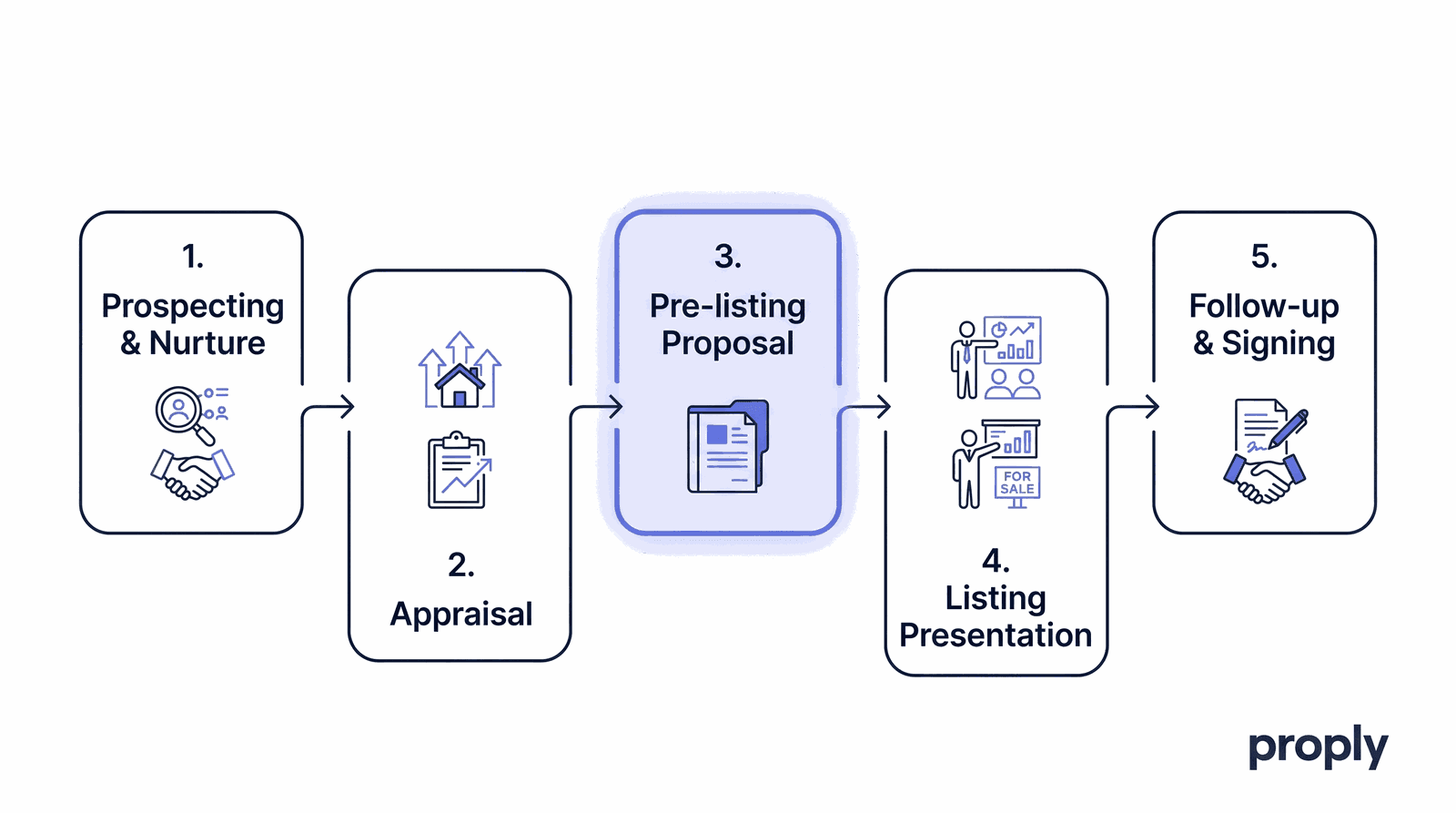
The point of mapping it this way is that each stage needs the right tool. Forcing a CRM to produce proposals, or treating the appraisal as the finish line, creates the gaps that show up in listing conversion rates. For how these categories fit together in the Australian market, see real estate software in Australia, and for the specific difference between the two core tools, CRM vs proposal software for real estate.
Want to strengthen the stage where listings are won? proply helps Australian agents turn appraisals into signed listings with structured digital proposals. See how it works – Book a demo – Start a free trial.
Download free – 64 pages on the pre-listing proposal workflow for Australian agents.
This article is part of the proply blog – practical guides for Australian agents on proposals, listing presentations and winning more listings. Explore the full series at proplyapp.com.au/blog.