Listing Presentation Template for Australian Agents
A listing presentation template built for Australian agents — covers market analysis, pricing strategy, marketing plan, fee structure and how to close.

A listing presentation template for Australian agents should follow this sequence: a brief agent and agency introduction (two minutes maximum, not self-promotional), a CMA section with comparable sales and price range, the proposed marketing strategy with specific portal and photography recommendations, commission structure and what's included, vendor next steps and expected timeline, and a call to action at the close. The most effective templates treat each section as a conversation prompt, not a monologue – the vendor should be speaking for roughly a third of the meeting. A pre-listing proposal document, sent 24 hours before the appointment, removes the need to cover basic credential questions in the room.
A listing presentation without a clear structure is a conversation without a destination. Agents who improvise the meeting sequence often spend too long on the wrong things – commission, agency branding, their personal story – and not long enough on the things vendors actually care about: what their property is worth, how you'll find them a buyer, and what working with you will look like.
A repeatable template solves this. Not a script – experienced agents don't need to read from notes – but a consistent sequence that ensures every vendor meeting covers the right ground in the right order. The structure keeps you in control of the conversation while leaving room to respond to what each vendor actually needs.
This guide sets out a clear listing presentation template agents can use for every appointment, from opening the meeting through to presenting the proposal and securing the next step.
What is a listing presentation template?
A listing presentation template is a structured sequence for running a vendor meeting – a repeatable framework that guides agents through the key stages of the appointment, from understanding the vendor's goals through to presenting pricing, marketing strategy and the proposal document.
It's not a slide deck and it's not a checklist. The checklist is what you prepare before the meeting. The template is how you run it. A well-constructed template gives every vendor the same high-quality meeting experience while allowing the substance – the data, the strategy, the proposal – to be specific to their property.

Why structure matters in listing presentations
Vendors are assessing you from the moment you arrive. They're watching how you take control of the meeting, how clearly you explain things, and whether you seem genuinely prepared for their situation or just running through a standard routine.
Structure signals competence. An agent who moves through a meeting with clear purpose – who explains what they're going to cover, delivers it logically, and guides the vendor to a clear next step – reads as more capable than an agent who covers the same content in a scattered order.
The REA Group Property Seeker Survey consistently shows that clarity and transparent communication are among the qualities vendors most want from their agent. A structured meeting is one of the most direct ways to demonstrate both. Vendors who feel well-informed and well-guided at the listing appointment are more likely to sign – and more likely to remain confident vendors throughout the campaign.
Want to see this in action? Book a proply demo
Listing presentation structure
A complete listing presentation moves through six clear stages:
- Open the meeting and set the agenda – establish structure and tone
- Understand the vendor's goals – before presenting anything
- Present market data and pricing – CMA, comparable sales, method of sale
- Present the marketing strategy – specific to this property and buyer profile
- Present the proposal and discuss fees – walk through the document, address commission directly
- Close and confirm next steps – never leave without a specific agreed action
Stage 1: Open the meeting and set the agenda
The first few minutes of a listing presentation determine the tone of everything that follows. Most agents waste them on pleasantries and agency preamble. Instead, use the opening to establish that you're running a structured meeting with a clear purpose.
What to do:
- Thank the vendor for their time and briefly explain the structure of the meeting: "I'd like to start by understanding what you're looking for from this process, then walk you through my read of the market, my marketing plan for the property, and the proposal I've put together. We'll have plenty of time for questions throughout."
- Confirm the time available and whether anyone else will be joining
- Set a collaborative tone – this is a conversation, not a pitch
What not to do:
- Open with your agency's market share statistics
- Spend the first ten minutes on your personal history
- Let the vendor drive the agenda before you've established the structure
A confident, structured opening tells the vendor they're in capable hands before you've said a single thing about their property.
Stage 2: Understand the vendor's goals
This is the most overlooked stage in most listing presentations – and the one that most improves everything that follows. Before you present anything, find out what the vendor actually wants.
Questions to ask:
- What's driving the decision to sell, and is the timing flexible or fixed?
- What outcome matters most – maximum price, certainty of sale, speed, or minimising disruption?
- Have they spoken to other agents, and what has that process told them so far?
- What's their experience of the property market, and how much do they want to be involved in campaign decisions?
The answers to these questions should reshape how you present the rest of the meeting. A vendor under financial pressure needs a different conversation than a downsizer with twelve months of flexibility. An experienced investor wants different information than a family selling their first home.
Agents who skip this stage deliver a generic presentation to a specific person. Agents who do it well deliver a presentation that feels like it was built for this vendor – because it was.
Stage 3: Present the market data and pricing discussion
With the vendor's goals established, move into the pricing conversation. This is where your CMA does its work.
Structure the pricing discussion:
- Set the context – briefly describe current market conditions in the suburb and what's driving buyer behaviour
- Walk through the comparable sales – explain why you selected each one and what it tells you about this property's position
- Present the current competition – the active listings this property will be competing against for the same buyers
- Give your recommended price range – with clear reasoning, not just a number
- Explain your recommended method of sale and why it suits this property and this market
Be direct about the numbers. Vendors respect agents who give a clear view rather than hedging to avoid conflict. If there's a gap between the vendor's expectations and the market evidence, address it here – with data, not opinion.
The pricing discussion is also where you demonstrate local knowledge. Data from platforms including Pricefinder, CoreLogic and PropTrack provides the foundation, but the interpretation – the context, the nuance, the street-level knowledge – is yours.
Stage 4: Present the marketing strategy
Once the vendor understands the pricing context, move to how you'll execute the campaign. The marketing plan should feel like it was built for this property – not a standard package pulled from a brochure.
Cover the following:
- The primary buyer profile for this property and how your strategy reaches them
- Recommended portal advertising – tier, duration and rationale
- Photography, video and copywriting approach
- Digital and social advertising strategy
- Database and off-market outreach
- Open home and private inspection approach
- Vendor reporting – how often, in what format, and what they can expect to hear
Explain the reasoning behind each decision. Vendors who understand why you're recommending a particular marketing approach are far more likely to support the budget required to execute it.
Stage 5: Present the proposal and discuss fees
This is the stage most agents handle least well – either rushing through it at the end of an overlong meeting, or avoiding a clear structure around fees altogether. Both undermine the vendor's confidence in your process.
The listing proposal is the document that formalises everything you've just discussed. A well-structured proposal covers pricing strategy, marketing plan, sales method recommendation, communication plan and fees – in a format the vendor can review after you've left the room and share with anyone else involved in the decision.
How to present it:
- Walk the vendor through the proposal document rather than just handing it over
- Explain each section briefly – confirm it reflects what you've discussed in the meeting
- Address fees directly: state your commission, explain what it covers, and be prepared to hold it
- Clarify what happens next – when the listing agreement would be signed, when photography would be booked, when the campaign would launch
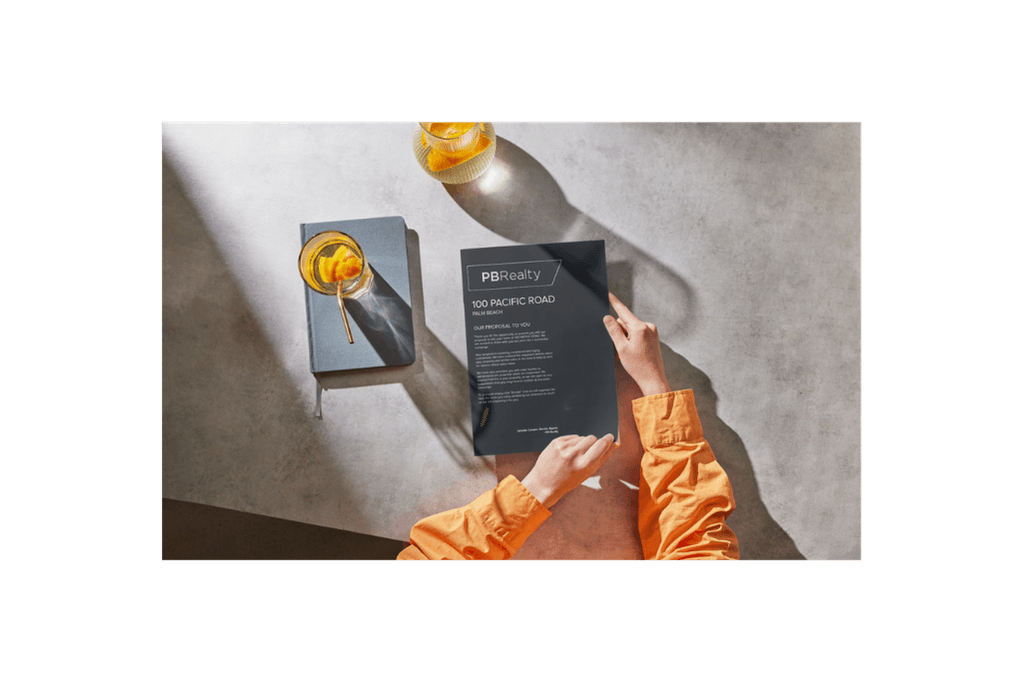
Agents increasingly use structured digital proposals for this stage. A digital proposal can be shared with the vendor after the meeting, revisited alongside a partner or family member, and updated quickly if anything needs adjusting before signing. For the proposal document itself, see the guide to real estate proposal templates. To explore purpose-built tools for building digital proposals, see the guide to proposal software for real estate agents.
In a proposal-first selling workflow, the proposal isn't a formality at the end of the meeting – it's the centrepiece. It's what vendors take away, compare, and ultimately decide on. Treating it as such changes how vendors experience the appointment.
A template only holds if it survives the tenth listing appointment. Agents who present the same structure every time generally stop rebuilding it in slides and move to a proposal they can generate. proply produces this six-stage structure as a written proposal the vendor keeps, which is the copy that gets reread after the meeting.
Stage 6: Close and confirm next steps
Listing presentations that end with "take your time and let us know" rarely result in a listing. Every meeting should end with a clear next step – one that the vendor agrees to before you leave.
How to close:
- Ask directly whether the vendor has any remaining questions on pricing, marketing or the proposal
- Confirm their timeline for making a decision and whether they're speaking to other agents
- Propose a specific next step – a follow-up call the following day, a time to discuss any outstanding questions, or an agreement to sign and begin campaign preparation
- Leave a printed copy of your proposal or send the digital version within the hour
If the vendor isn't ready to decide, that's fine – but confirm when you'll speak again. An open-ended "we'll be in touch" is not a next step.
For a breakdown of where agents most commonly go wrong in vendor meetings, see the guide to why most listing presentations fail.
Download free – 64 pages on structuring the appraisal, proposal and listing appointment as one workflow.
Ready to see proply in action? Book a proply demo · Start your free trial
This article is part of the proply blog – practical guides for Australian agents on proposals, listing presentations and winning more listings. Explore the full series at proplyapp.com.au/blog.