AI Real Estate Tools: What Australian Agents Are Using in 2026
The AI tools real estate agents are actually using in 2026 — content generation, proposals, marketing automation and data-driven pricing support.

The AI tools most relevant to real estate agents in Australia fall into five categories: listing copy and property description generators, social media content tools, CRM and follow-up automation, proposal and presentation builders, and conversational AI for vendor and buyer queries. Purpose-built tools for real estate (like those designed specifically for listing workflows) tend to save more time than adapted general tools, because the templates and prompts are already structured for the industry. The most-used tools among Australian agents as of 2025–26 are OpenAI's ChatGPT for copy drafting, Canva AI for marketing assets, and proposal software with built-in AI for pre-listing documents.
The number of AI tools available to real estate agents has grown considerably in the past two years. Some are purpose-built for the industry. Others are general AI tools that agents have adapted to real estate workflows. Together they are beginning to reshape how agents prepare listings, market properties and manage administrative work.
Understanding what is available – and where each type of tool actually helps – is more useful than chasing every new product that enters the market. This guide provides a practical overview of the AI tool categories agents are currently exploring and where they fit in the workflow.
What are AI tools for real estate agents?
AI tools for real estate agents are software applications that use artificial intelligence to assist with tasks across the listing, marketing and administration workflow. These include tools for content generation, proposal preparation, campaign analysis, workflow automation and data-driven pricing support.
Most AI tools currently available sit in one of two categories: standalone AI tools that agents have adapted for real estate use, and purpose-built proptech platforms with AI features built directly into existing workflows.
Why AI tools are emerging across the proptech ecosystem
Real estate has historically been a high-touch, high-effort industry. Agents spend significant time on tasks that are repetitive but still require professional quality output – writing copy, preparing proposals, producing vendor reports and managing follow-up communications.
Deloitte's real estate predictions research identifies document preparation and client communication as two of the highest-friction areas in agent workflows. These are exactly the areas where AI tools are currently having the most impact.
The broader technology context matters too. AI capability improved dramatically from 2022 onwards, and the cost of accessing that capability dropped significantly. This made it practical for proptech companies to embed AI features into existing platforms rather than building separate AI products. The result is that AI is appearing across the tools agents already use, not just as new standalone products.
Types of AI tools agents are experimenting with
The current landscape spans several distinct categories:
General AI writing tools – ChatGPT, Claude, Gemini and similar tools are being used by agents for drafting listing copy, preparing market summaries, writing client emails and generating FAQ content. These tools are not purpose-built for real estate but are highly adaptable with good prompting.
Purpose-built proptech AI tools – Platforms built specifically for real estate with AI features integrated. These typically connect to property data and CRM records, allowing AI to work with actual listing information rather than generic inputs.
AI features within existing platforms – REA Group, Domain, and a growing number of CRM and campaign management platforms are embedding AI features directly into their products. Agents access these as part of existing subscriptions rather than adopting new tools.
AI-assisted data and pricing tools – Property data platforms including Pricefinder, CoreLogic and PropTrack are incorporating AI-assisted analysis features for market reporting and comparative analysis.

McKinsey's research on agentic AI in real estate consistently shows that tools embedded in existing workflows achieve higher adoption rates than standalone tools requiring new processes. This is why the most impactful AI tools for agents are often those appearing inside the software they already use daily.
AI tools for marketing and content
Content generation is currently the highest-volume AI use case in real estate. The tools most commonly used in this category:
Listing description writers – AI tools that take property details as input and produce portal copy, social captions and email content. General tools like ChatGPT perform well here with specific prompting. Purpose-built real estate content tools offer templates designed for property types and portal formats.
Image-to-copy tools – Some tools can analyse property images and generate descriptive copy based on what is visible. Useful for speed, though agent review is essential for accuracy.
Social media content tools – Tools that automate the creation of social posts from listing data, including scheduling. Some CRM platforms include this functionality natively.
For a deeper look at how AI is changing the marketing workflow specifically, the AI real estate marketing guide covers this in detail.
AI tools for listing preparation and proposals
Proposal preparation is an area where AI is creating meaningful time savings for agents. The tools used here tend to be a combination of general AI writing tools and purpose-built proposal platforms.
AI writing tools in proposal preparation – Agents use tools like ChatGPT or Claude to draft market overview sections, comparable sales narratives, pricing strategy explanations and vendor FAQ content. These drafts are edited and incorporated into the proposal document.
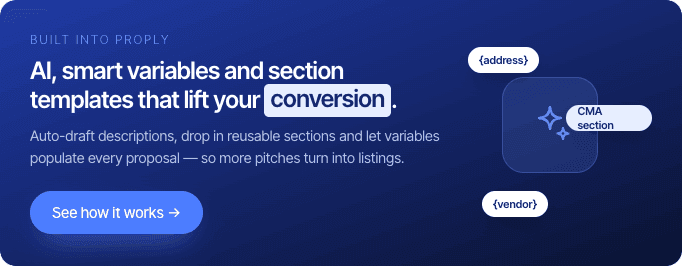
Structured proposal platforms with AI support – proply provides the structural framework for a listing proposal – the format, sections and vendor-facing layout – while AI assists with generating and populating written content. The combination of structure and AI-assisted content produces faster, more consistent proposals without reducing the quality of the final document.
Proposal-first selling workflows benefit significantly from this combination. The framework handles consistency; AI handles speed; the agent handles accuracy and local context.

For more on how AI fits into the proposal preparation process, see the AI for listing proposals guide, or explore proposal software for the platform overview.
AI tools for workflow automation
Beyond content and proposals, AI is beginning to assist with the administrative and communication tasks that consume agent time outside of vendor-facing work.
Email and follow-up automation – AI tools that draft follow-up emails based on open home attendance records, enquiry data or CRM triggers. Agents review and send; the drafting is handled automatically.
Meeting summaries and notes – AI transcription and summarisation tools are being used by agents after vendor calls and appraisals to produce clean notes that feed back into CRM records and proposal preparation.
Vendor report generation – Campaign performance data from portals is increasingly being summarised using AI, producing clear vendor-facing reports faster than manual compilation.
Enquiry qualification – Some platforms are testing AI-assisted enquiry qualification, flagging buyer leads based on engagement signals. This is earlier stage than the content tools but is developing quickly.
The real estate software guide covers how these tools sit within the broader technology stack agents are using.

Download free – 64 pages on using AI to power a more consistent pre-listing proposal workflow.
Ready to see proply in action? Book a proply demo · Start your free trial
This article is part of the proply blog – practical guides for Australian agents on proposals, listing presentations and winning more listings. Explore the full series at proplyapp.com.au/blog.